
- Home
- By Industry
- Custom Packaging
- Our Products
- Blogs
- Request Quote
Quick Takeaways
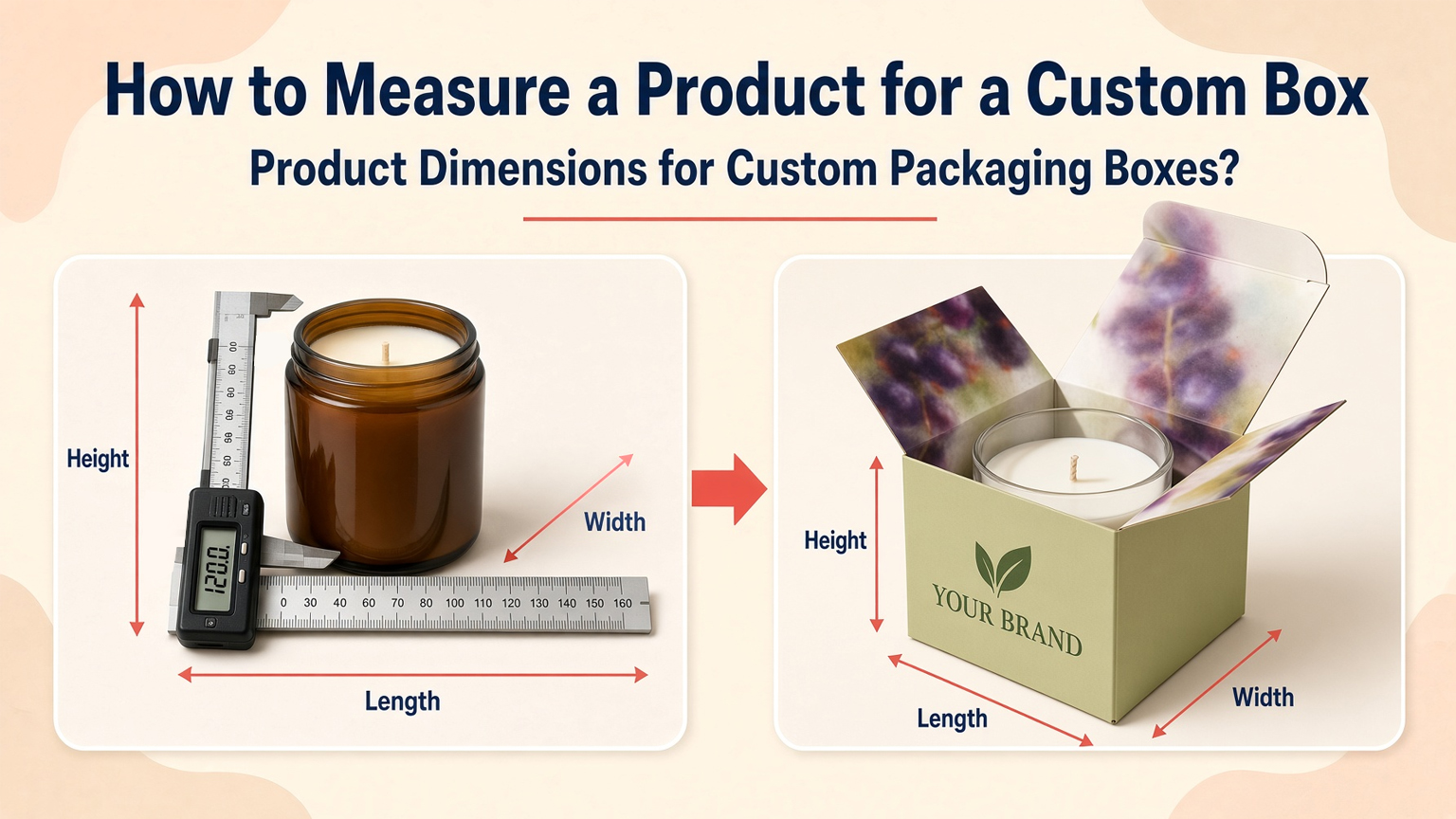
To measure a product for a custom box, set it the way it will sit in the box. Then measure its longest, widest and tallest points, including caps, pumps and handles. Record the numbers as L × W × H in one unit. Your manufacturer adds room for inserts, wrapping and the box structure to set the internal dimensions.
iCustomBoxes Canada, a custom packaging manufacturer, needs these measurements for every quote.
Box dimensions describe the opening first. Under the FEFCO box code, length is the longer side of the opening, width is the shorter side, and height runs from the opening to the base.
|
Dimension |
What it measures |
Watch for |
|---|---|---|
|
Length (L) |
Longer side of the opening |
On hinged boxes, note which side the lid hinges on |
|
Width (W) |
Shorter side of the opening |
Some suppliers call it breadth |
|
Height (H) |
Opening to base |
Often called depth; on custom mailer boxes it's usually the smallest number |
Custom box dimensions are internal: the usable space inside. External dimensions add the board thickness on every wall.
|
Internal |
External |
|
|---|---|---|
|
Measures |
Usable space inside |
Total outside size |
|
Use it for |
Product and insert fit |
Shelf space, outer cartons, courier charges |
|
Board thickness |
Doesn't change it |
Makes it larger |
No single clearance figure suits every box. A snug retail carton may need only enough room to slide the product in. FedEx Canada's packing guide, by contrast, calls for 3 in (8 cm) of cushioning around double-boxed fragile items.
Clearance depends on:
Treat your calculation as a starting point. Your manufacturer should set the final clearance once the box style, stock and insert are chosen.
Inserts and dividers: Add the insert's wall thickness on both sides, plus any floor under the product. See our custom packaging inserts for options.
Multiple items: Arrange them in the final layout and measure the group. Canada Post recommends cushioning between different items in one box.
Wrapping: Wrap the product as you'll pack it, then measure again.
Bottles and jars: Measure diameter at the widest point, often the shoulder or cap.
Irregular items: Measure the smallest rectangle the product fits inside.
Soft goods: Measure them folded the way they'll be packed.
A Serum Bottle
Illustrative only. The allowances below are assumptions for this example, not packaging standards.
A glass dropper bottle is 34 mm wide and 118 mm tall with its dropper. It packs upright in a tuck-end custom serum box with a paperboard insert. We assume a 1.5 mm insert wall, a 1 mm gap per side and 2 mm above the cap.
Starting size: 39 × 39 × 120 mm (about 1.54 × 1.54 × 4.72 in). Confirm the final size once the stock and insert are fixed.
|
Information |
Why it matters |
|---|---|
|
Product name and photos |
Shows shape and fragile areas |
|
L × W × H at greatest points |
Starting point for internal size |
|
Unit (inch, cm or mm) |
Prevents mix-ups |
|
Product weight |
Guides stock and structure |
|
Packing orientation |
Sets which side is height |
|
Quantity |
Affects unit price |
|
Insert or protection needs |
Changes internal space |
|
Box style |
Changes how dimensions are read |
|
Printing and finish |
Needed for accurate pricing |
Our quote form accepts inches, centimetres or millimetres, and you can attach photos. Our team can suggest a size based on your product's dimensions, weight and shipping method. You'll also review a 2D/3D digital proof before production, as our custom box FAQ explains.
Measure the product at its greatest points, note your inserts and let your manufacturer confirm the final size. Request a custom box quote with your measurements, and we'll help you find the right fit.
Q: Should I give a box manufacturer product dimensions or box dimensions?
Give your product dimensions, measured at the greatest points, and say how it will be packed. The manufacturer works out the internal box size.
Q: Are custom box dimensions measured inside or outside?
Inside. Uline, for example, lists all box dimensions as inside dimensions, with height excluding the flaps.
Q: Can I use inches or millimetres when ordering custom boxes?
Yes. Use one unit throughout and state it. Millimetres avoid fractions on small products.
Q: How do I measure a product with a pump, cap or handle?
Measure with the part attached, in the position it will sit in the box.
Q: How accurate are custom box dimensions?
Uline cites an acceptable variance of ±1/8 in for its boxes. Ask your supplier for its tolerance if your product fits tightly.


